
This is the ninth article in our Asset Management Value Roadmap series. In the previous articles in this series, we have given several practical tips for implementing changes in Asset Management processes and practices that will deliver greatest value to an organisation. In this article, we will focus on providing tips to ensure that these benefits are sustained.

Sustaining the Benefits of Better Asset Management
Changing an organisation’s culture (and therefore obtaining true value from Asset Management) is not a six-month project. It is not a twelve-month project. In most organisations, meaningful cultural change takes three to five years at a minimum.
As one example, Network Rail, born out of the (literal) wreckage that was Railtrack, embarked on a significant Asset Management improvement program in 2006. This improvement program yielded significant benefits, including:
- Reduced Capex – an initial focus on the highest spend asset group (Track) resulted in extended asset lives and a reduction of capital spend by around 20%
- Reduced Opex – operating and maintenance costs per vehicle kilometre reduced by 46% between 2003/04 to 2011/12
- Improved asset performance – reliability and sustainability improved, e.g., incidents of broken rails reduced from 322 in 2004/05 to 125 in 2011/12.
- Better regulatory outcomes – Network Rail could provide evidence to demonstrate that their decision-making approach is sustainable over the long term
- Safety – Network Rail claims to be Europe’s safest ‘major’ railway, significantly safer than road and comparable with air transport.
- Usage increase – the network carries more trains than ever before, with 10% more train kilometres and 3% more freight moved than in 2004/05
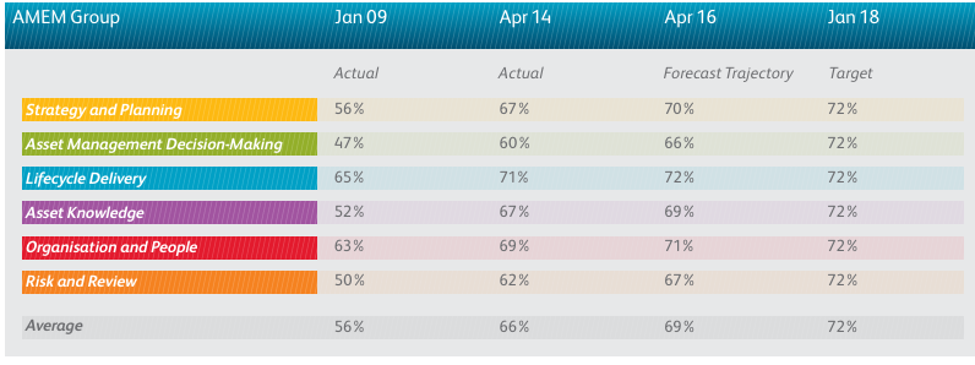
The following table shows their actual Asset Management Maturity scores in 2009 and 2014, and their forecast trajectory towards their target Maturity Score of 72%.
See Asset Management Strategy document.
Note that it took them 5 years to increase their overall Asset Management maturity from 56% to 66%, and they were predicting that it would take a further 4 years to achieve their target level of maturity of 72%.
This has significant implications for other organisations who wish to embark on a similar, large scale Asset Management improvement program.
The first message, clearly, is that true Asset Management improvement cannot be achieved within 6 to 12 months – which is the typical duration of an Asset Management Improvement project expected by senior leadership.
The second implication relates to how, and by whom, Asset Management Improvement needs to be driven within an organisation. If it truly takes five years or more to demonstrate significant improvements, then this exceeds the typical length of tenure of a senior executive within most organisations. If the organisation wants to stay the course, and ensure that improvement efforts yield the greatest benefits, then the organisation cannot afford to allow the project to be owned and driven by a single individual.
Given the requirement for cross-functional engagement across many parts of the business, and the long-term nature of the effort required, a pre-requisite for value to be derived from Asset Management is that effective Asset Management needs to be embraced as a core part of the organisation’s strategy, and the project to improve Asset Management performance needs to be seen as a key strategic initiative driven not by a single individual, but by the organisation’s senior leadership team.
To achieve the long-term, cultural change that is required to deliver the full benefits from better Asset Management, senior leaders need to model the behaviours they expect from their teams. They need to consistently reinforce the importance of asset management objectives through their decisions and communications. And they need to maintain that consistency of purpose even when short-term pressures create temptation to cut corners or defer investment.
The Role of the Asset Management Function in Sustaining Asset Management Benefits
Throughout this series of articles, I have made reference to an “Asset Management Improvement Project”. There is no doubt that establishing a project such as this is required in order to make a step change in Asset Management performance (and consequential improvement in business outcomes). Like all projects, it needs:
- a clear charter
- definition of the expected outcomes to be achieved
- a list of the activities to be performed, by whom and by when
- to be adequately resourced, and
- formal project management and control
The problem with all projects is that once they (hopefully) achieve their intended outcomes, then the project team disbands. At that point (also hopefully) the Asset Management processes and systems required to deliver organisational benefits should now be fully embedded within the organisation, and the new ways of working should now be considered as “Business as Usual”.
Unfortunately, however, there is a fundamental universal principle called entropy that applies to physics as well as to organisational systems. This principle, in essence, states that processes move from concentrated, ordered states to dispersed, disordered ones. When applied to human behaviour, organisations and the systems that exist within those organisations, it means that without intentional effort to maintain habits, relationships and business processes, organisational systems naturally degrade into less functional states.
In short, this means that sustaining the benefits of Asset Management in the long-term requires a constant injection of energy and effort into maintaining the habits, processes and systems that underpin sound Asset Management. How is this to be achieved?
One, practical way of achieving this is by establishing and empowering a dedicated Asset Management function within the organisation. Some have called this an Asset Management Office (AMO) but the name is less relevant than what it is expected to do, and the standing that it has within the organisation.
The key roles of the Asset Management function are to:
- Ensure that the organisation’s Asset Management System – the processes and procedures and supporting elements that are intended to deliver value to the organisation – continue to support achievement of the organisation’s overall objectives
- Ensure that the organisation’s Asset Management system continues to conform with relevant external standards (such as ISO 55001), if relevant, and comply with other external regulatory or contractual requirements. In some industries, the Asset Management function may also be involved in the development of regulatory submissions (for example to economic regulators).
- Maintain and update the organisation’s Asset Management System as required
- Provide a layer of governance over the organisation’s Asset Management system – monitoring and reporting compliance with documented processes and procedures
- Ensure that the Asset Management competences required for effective Asset Management performance are defined, updated as required, and exist within the organisation
- Encourage and support effective cross-functional alignment and coordination across the entire asset lifecycle, as well as with relevant support functions, such as IT, HR, Finance and Procurement.

Given the cross-functional nature of Asset Management, to effectively perform these duties, it is essential that the Asset Management function:
- Has a clear mandate from senior management to perform the above activities
- Holds sufficient power within the organisation to influence and/or enforce compliance with the organisation’s Asset Management system
- Has sufficient, competent resources to perform its duties
In practice, this means that the Asset Management function will need to report to the Chief Operating Officer or higher, and that Asset Management will need to be a standing item to be discussed at Executive Leadership team or Board meetings within the organisation.
Practical Tips
Some practical tips for implementing the key points made in this article are as follows:
- Communicate, when starting out to improve Asset Management within the organisation, that maximum benefits will only be realised if the organisation permanently changes the way that it manages its assets. Processes, systems, behaviours, habits and culture may all need to be permanently adjusted. It may be helpful to use the following analogy. Experts recognise that permanent weight loss can only be realised when eating habits permanently change – the concept of “going on a diet” implies that at some point you finish being on a diet and can go back to your old eating habits – this thinking is fundamentally flawed, because it was your old eating habits that led to you being overweight in the first place. In the same way, if benefits are to be sustained, the organisation cannot “do” Asset Management as a project and then revert to its old ways of working.
- Recognise that achieving this, particularly in large organisations with firm, established processes, systems and culture, will take considerable time. Be prepared for the improvement project to last 5 years or more.
- Ensure that Asset Management, as a concept, is embraced at the most senior levels within the organisation – Executive Leadership Team or Board of Directors, embedded as a key plank of the organisation’s strategy, and that Asset Management improvement is considered as being a vital Strategic initiative.
- Ensure that a strong Asset Management function is established within the organisation that is given the sufficient power to monitor and influence compliance with the organisation’s Asset Management system, and sufficient resources to be able to continually inject the necessary energy into that system to maintain and improve it as required to ensure that it continues to deliver the organisational benefits expected.
Summary
This is the final article in this series on ensuring that Asset Management delivers value. This series of articles made the following key points:
- ISO 55001 can encourage a document-centric approach, but deriving real value from Asset Management depends on changing behaviours, not simply producing policies and plans.
- Value must be defined by understanding stakeholder needs and expectations, recognising that trade-offs between cost, benefit, risk and time are unavoidable.
- Clear, aligned SMART objectives are needed to translate organisational value into practical asset management decisions.
- Asset management has a broad scope and involves most organisational functions, not just maintenance or engineering. As a result, transformational improvement requires coordinated, organisation-wide effort rather than isolated functional initiatives.
- Sustained improvement requires changes in behaviours and organisational culture
- Behavioural change is both emotional and rational, so change programs must address people’s concerns, motivations and habits. Using structured change models such as ADKAR can help with this.
- Senior leaders and other individuals play a vital role in changing behaviours and organisational culture by defining expected behaviours, leading by example, creating rituals, recognising good behaviours and sharing stories.
- Generating significant asset management improvement is a long-term commitment, often requiring five years or more. Because of this, asset management should be embedded in organisational strategy and visibly supported by senior leadership or the board.
- Without ongoing effort, asset management systems naturally degrade over time. A dedicated and empowered Asset Management function can help avoid this.
To read the other articles in this series, visit:
Article 1: Understanding Asset Management: The Foundation for Value Creation
Article 2: ISO 55000 and ISO 55001: Understanding the Standards and Their Limitations
Article 3: 6 Key Tips for Generating Value from Better Asset Management
Article 4: Understanding What Value Means to Your Organisation
Article 5: Asset Management Involves Everyone
Article 6: Align Every Decision With Organisational Objectives
Article 7: The Real Reason Your Asset Management System Looks Good on Paper but Fails in Practice
Article 8: Why Asset Management Success Depends on Culture