
This is the fifth article in our Asset Management Value Roadmap series . This series of articles is designed for asset managers, senior leaders, and operational decision-makers seeking to obtain greater value from their organisation’s physical assets.
In this article, we will explore the scope of Asset Management and examine what that means for employee engagement in most organisations in Asset-intensive industries.
In short, we will see that Asset Management reaches into many departments and functions that, traditionally, would not consider themselves as being involved in Asset Management and that, as a result, large-scale improvements in Asset Management performance require an organisation-wide approach.
GFMAM and the Asset Management Landscape
The Global Forum on Maintenance and Asset Management (GFMAM) is the peak international body for the Asset Management profession. Its members include professional bodies involved in Asset Management including the Asset Management Council (Australia), the Institute of Asset Management (UK), PEMAC Asset Management Association of Canada, the European Federation of National Maintenance Societies (Europe), and many more. One of its most important contributions to the field of Asset Management is its document, the Asset Management Landscape.
The Asset Management Landscape outlines the subjects and fundamentals that define the discipline of Asset Management, and provides a high-level framework for Asset Management which represents the global Asset Management community’s best understanding of the scope of Asset Management. The third edition of the Landscape, published in 2024, defines 40 distinct subjects across 7 broad areas as illustrated below.
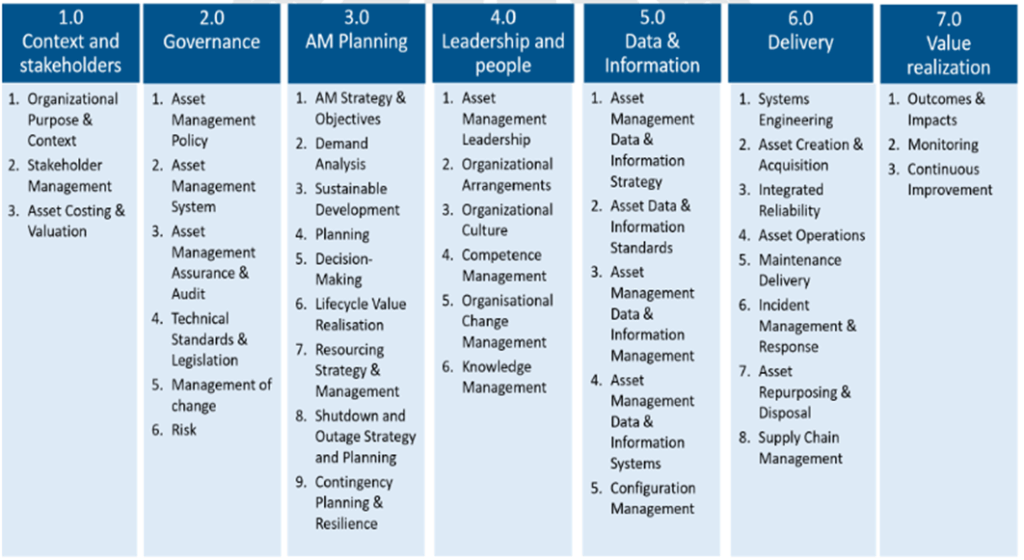
The 40 subjects of the Asset Management Landscape
Let’s briefly consider the key focus and activities in each subject.
1. Organisational Purpose and Context
- Identify and assess internal and external stakeholders and their requirements.
- Develop governance, enterprise risk, compliance, and policy frameworks.
- Develop Strategic/business plan and objectives.
2. Stakeholder Management
- Identify key stakeholders, their level of influence and impact, and their needs and requirements.
- Develop stakeholder strategies and plans (including consultation and communication).
- Plan and execute the stakeholder processes.
- Analyse and understand, monitor and evaluate the effectiveness of stakeholder management.
3. Asset Costing and Valuation
- Understand the costs and revenue generated by assets and their subsequent drivers.
- Ensure compliance with financial accounting standards.
4. Asset Management Policy
- Develop policy establishing guiding principles for Asset Management
- Provide a mandate to the organisation to implement Asset Management
5. Asset Management System
- Develop and maintain a management system that defines and guides the delivery of Asset Management in the organisation.
6. Asset Management Assurance and Audit
- Develop and implement processes for reviewing and auditing the effectiveness of asset management processes and the asset management system.
7. Technical Standards & Legislation
- Ensure asset management activities are compliant with the relevant technical standards and legislation.
8. Management of Change
- Identify, assess, implement and communicate changes to people, processes and assets.
9. Risk
- Identify, quantify and mitigate risk and exploit opportunities.
10. Asset Management Strategy and Objectives
- Establish Asset Management Objectives
- Develop a high-level approach for meeting these objectives.
11. Demand Analysis
- Understand and forecast future demand for products and services
12. Sustainable Development
- Ensure an enduring, balanced approach to economic activity, environmental responsibility and social progress to ensure all activities are sustainable in perpetuity.
13. Planning
- Develop and maintain a Strategic Asset Management Plan and lower-level plans for achieving Asset Management objectives which are aligned with corporate objectives
14. Decision-Making
- Evaluate and select the optimum option from among alternatives. This could include decisions relating to, among others:
- The acquisition, upgrade, modification, disposal or repurposing of assets
- Selection and prioritisation of the Operations and Maintenance activities necessary to meet Asset Management objectives
- Identification of optimum spare parts holdings
- Repair vs Replace decisions
- Inhouse vs Outsource decisions
- Etc.
15. Life cycle Value Realisation
- Establish and apply methods to balance the costs, benefits and risks of Asset Management activities throughout assets’ lifecycles.
16. Resourcing Strategy and Management
- Establish and implement processes used to procure and use people, plant, tools and materials to meet Asset Management Objectives & Plans.
17. Shutdown and Outage Strategy and Planning
- Scope and schedule shutdown and outage activities
- Establish and maintain processes for identification, planning, scheduling, execution and control of work related to shutdowns or outages
18. Contingency Planning & Resilience Analysis
- Establish and maintain processes and systems to mitigate or manage the risks associated with a significant event
19. Asset Management Leadership
- Provide the leadership required to promote a whole of life asset management approach to deliver maximum value to the organisation.
20. Organisational Arrangements
- Establish an organisation structure, roles and responsibilities which permit the organisation to achieve its Asset Management objectives
21. Organisational Culture
- Establish and maintain an organisational culture which enhances its capability to deliver value.
22. Competence management
- Establish and maintain processes to develop and maintain an adequate supply of competent and motivated people to fulfil the organisation’s asset management objectives.
23. Organisational change management
- Establish and maintain processes to support individuals through changes in Asset Management processes, technology, organisational alignment, and culture.
24. Knowledge Management
- Establish and maintain processes for identifying, capturing, organising, retaining and transforming tacit knowledge into explicit knowledge of assets, the management system, and Asset Management.
25. Asset Management Data & Information Strategy
- Determine and document the strategic approach to the definition, collection, management, disposal, analysis, reporting and overall governance of asset Management data and information.
26. Asset Data & Information Standards
- Develop and maintain the specification of a consistent structure and format for the acquisition, maintenance and use of asset and asset management data and information.
27. Asset Management Data & Information Management
- Manage and govern the data and information held within an organisation’s asset management information systems.
28. Asset Management Data & Information Systems
- Specify and manage the asset management data and information systems in place to support asset management activities and decision-making processes.
29. Configuration Management
- Establish and maintain consistency of an asset’s physical and functional attributes with its design and operational information throughout its life cycle.
30. Systems Engineering
- Develop and implement policies and processes to derive, evolve and verify a life cycle balanced system solution that satisfies stakeholder expectations.
31. Asset Creation & Acquisition
- Acquire, install and commission of assets.
32. Integrated Reliability
- Develop and implement of processes for ensuring that an item shall operate to a defined standard for a defined period in a defined environment.
33. Asset Operations
- Operate assets to achieve business objectives.
34. Maintenance Delivery
- Manage and execute preventive and corrective maintenance activities to ensure that assets meet the desired levels of performance.
35. Incident Management and Response
- Respond to failures and incidents in a systematic manner, including incident detection, fault analysis, temporary and permanent repairs.
36. Asset Repurposing and Disposal (incl renewal)
- Decommission, retire, repurpose, reclaim and dispose of assets at the end of their useful life.
37. Supply Chain Management
- Ensure that all purchased products and services associated with Asset Management activities maximise value.
38. Outcomes and Impacts
- Assess how well Asset Management activities achieve their objectives and how these objectives contribute to the organisation’s objectives to meet stakeholder needs and expectations.
39. Monitoring
- Evaluate the condition and performance of assets and the asset management system throughout their life cycle.
40. Continuous Improvement
- Analyse performance, identify opportunities, and make incremental changes to increase the value generated by assets.
Implications for Organisational Functions
If these 40 subjects truly do represent the scope of Asset Management, then let’s consider which business functions are involved in each of these subject areas. This is mapped in the tables below.
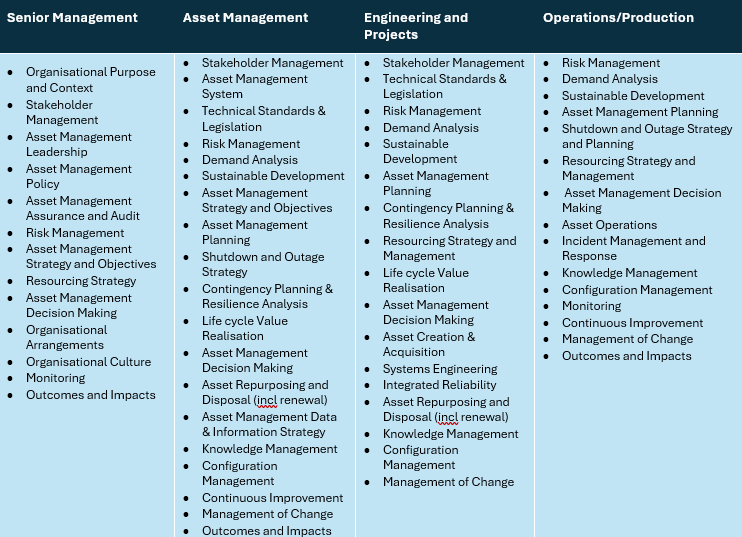
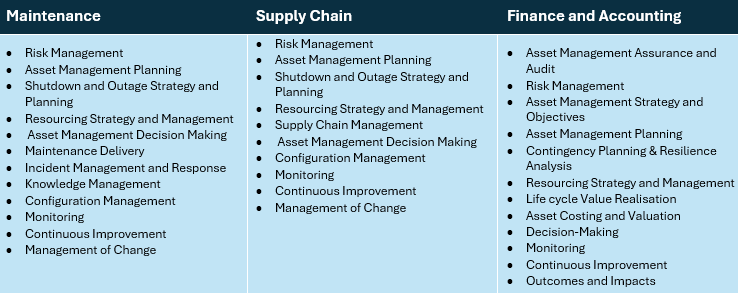
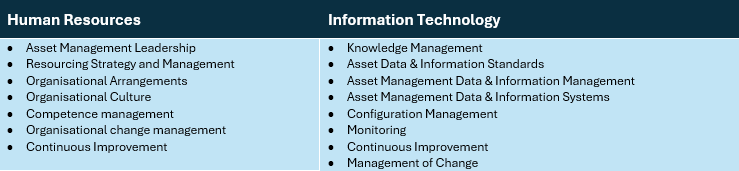
The wide range of departments involved in Asset Management immediately becomes highly apparent.
In an organisation in a capital-intensive industry, it is likely that almost all employees are involved in Asset Management in some way. For a large organisation, this may add up to hundreds, if not thousands, of employees.
Implementing improvements in Asset Management processes and systems is, therefore, likely to impact on many, if not all, of these individuals, and they will likely need to change what they do, and how they do it, if meaningful improvements in Asset Management performance are to be realised.
A whole-of-business improvement program is likely to be required if coordinated activity across all of these functions is to be achieved. While it is possible that some benefits could be delivered through improvement projects with more limited scope (e.g. by improving coordination between operations and maintenance relating to the integration and alignment of operational plans and maintenance plans, or improving the quality of handover of projects from engineering to operations) transformational improvement can only be achieved by engaging with most, if not all, organisational functions.
Summary
In summary,
- The scope of Asset Management is wide
- Asset Management involves most, if not all, functions within an organisation
- Maximising the value derived from assets requires coordinated activity between all of these functions
- As a result, transformational Asset Management improvement requires an organisation-wide approach.
In the next article in this series, we will discuss the importance of ensuring that all Asset Management decisions are aligned with the achievement of organisational objectives and offer some tips on how to make this happen.
This article is part of the Asset Management Value Roadmap series by Assetivity. To read the previous articles in this series, visit:
Article 1: Understanding Asset Management: The Foundation for Value Creation
Article 2: ISO 55000 and ISO 55001: Understanding the Standards and Their Limitations
Article 3: 6 Key Tips for Generating Value from Better Asset Management
Article 4: Understanding What Value Means to Your Organisation
Article 5: Asset Management Involves Everyone
Article 7: The Real Reason Your Asset Management System Looks Good on Paper but Fails in Practice