
This is the sixth article in our Asset Management Value Roadmap series . This series of articles is designed for asset managers, senior leaders, and operational decision-makers seeking to obtain greater value from their organisation’s physical assets.
Goals vs Objectives: Understanding the Difference
ISO 55000:2024 defines an objective as a result to be achieved. Simple enough. But in practice, what we frequently see organisations calling “objectives” are actually goals dressed up to look like objectives.
So what is the difference?
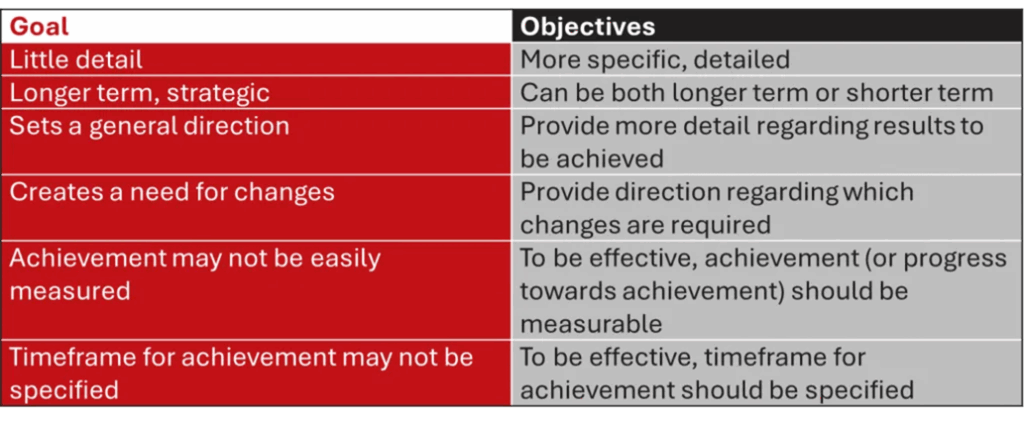
A goal is a broad, aspirational statement of direction. It is useful for motivating people and providing a general sense of where the organisation is heading, but it lacks the specificity needed to guide day-to-day decision making. Goals are typically long-term in nature and difficult to measure with precision.
An objective, on the other hand, is, ideally specific, measurable, and time-bound. It should clearly establish what needs to be achieved, by when, and to what standard. If established well, it gives decision-makers a clear reference point for prioritising activities and allocating resources.
- Specific – details the precise outcome to be achieved
- Measurable – achievement of the objective, or progress towards achievement of the objective should be able to be measured
- Achievable – those accountable for meeting the objective must accept that it is possible to attain
- Relevant – the objective should be relevant to the achievement of higher level goals and objectives
- Time-bound – the timeframe for achievement of the objective should be specified
Note that ISO 55001:2024 does not require objectives to be SMART – only that they should be measurable, if practical. However, we strongly recommend that SMART objectives be developed, if at all possible, as this makes the identification, selection and prioritisation of actions required to achieve those objectives much clearer.
The comparison between goals and objectives is summarised in the following table.
To illustrate the difference, consider the following example from a major publicly listed organisation. These are their publicly stated objectives:
- Become Best Operator, through great teams bringing their best every day, to safely and sustainably realise the full value of our assets.
- Strive for impeccable ESG credentials by aligning our priorities with society’s expectations and considering safety and sustainability in every decision.
- Excel in development by shaping our portfolio for the future while progressing our existing project pipeline on time and to budget.
- Strengthen our social license by building meaningful partnerships, listening and learning, and earning trust.
These statements are admirable. They are motivating. They give a general sense of the organisation’s direction. But are they objectives? Can you look at them and determine whether the organisation is on track to achieve them? If you were managing an asset portfolio with limited funding and had to decide which of these priorities to focus on, how would you choose? What if delivering “impeccable ESG credentials” required investment that came at the expense of “realising the full value of our assets” from a financial perspective?
The honest answer is that these are goals, not objectives. They provide direction but not decision-making clarity.
Now contrast those with the following example from a rail organisation:
- Achieve zero fatalities as a result of asset failures across all rail lines.
- Achieve rolling stock reliability of 1,000k train-km between failures by 2028 and 1,500k train-km between failures by 2032.
- Commission by 2030 an asset information system that supports a predictive and preventive maintenance regime and lifecycle cost analysis.
- Implement a Risk Management Framework and complete assessment of asset criticality across the entire asset base by 2030, with maintenance, replace, and renewal decisions driven by this framework by 2032.
- Obtain ISO 55001 certification by 2028.
- Optimise train fleet to achieve maximum peak period passenger loading of less than 4 passengers per square metre.
The difference is immediately apparent. If your rolling stock reliability in 2025 is 500,000 train kilometres between failures and you know the target is to reach 1,000,000 MKBF by 2028, that focuses decision-making. It tells you the size of the gap you need to close. It tells you that a step change improvement in performance is required – not a small, incremental improvement. As a result, it tells you what kinds of maintenance and reliability activities need to be prioritised. That is genuinely useful.
Using Objectives to define Value
Objectives can be established in many dimensions – for example, an organisation could have production objectives, cost objectives, safety objectives, customer service objectives and so on.
We saw in the first article in this series that Value can be considered to consist of four fundamental dimensions – Cost, Benefit, Risk and Time.
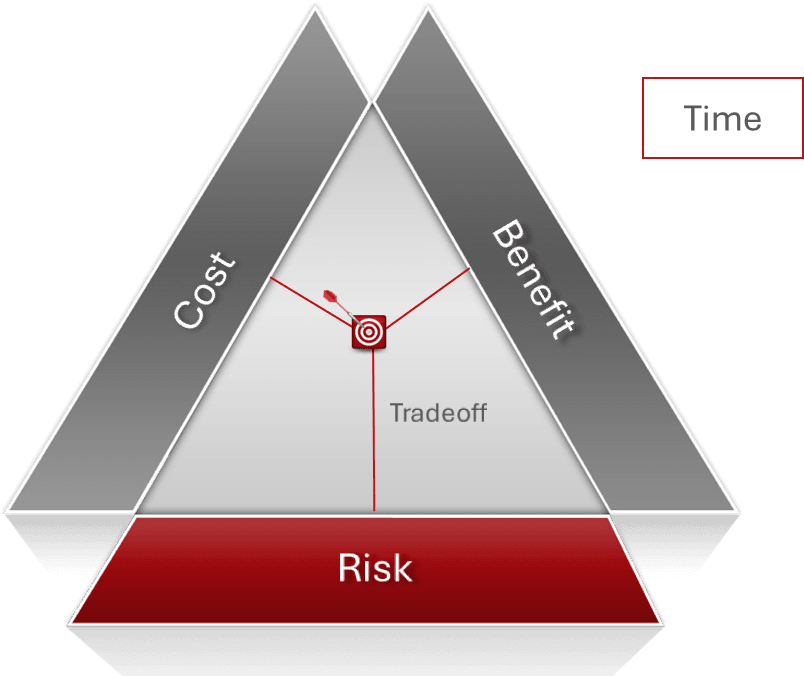
It is possible to map an organisation’s objectives to these four dimensions. So, for a mining organisation, for example, the mapping could look something like the following:
| Value Dimension | Objective Area |
| Cost | Cash cost of production (per tonne) Capital Expenditure |
| Benefit | Production output Product Quality |
| Risk | Safety Performance Environmental Performance Statutory Compliance |
| Time | Sustainability – Financial, Environmental and Social |
We also discussed in that first article that value creation involves trade-offs between these four dimensions. If we have established SMART objectives in each of these areas above, it is important, therefore, to ensure not only that each objective is achievable on its own, but that all objectives are achievable as an integrated suite of objectives.
If, for example, achieving a more aggressive environmental target (e.g. Net Zero Carbon emissions by 2030) will require significant additional capital expenditure and will also increase operating costs, then this must be recognised when establishing the cost objectives in those areas. This requires active collaboration between the diverse parts of the organisation that are responsible for setting, and achieving, those targets.
If a truly integrated, aligned, specific, measurable and achievable set of organisation-wide objectives for a specified time period can be established, however, this defines value for the organisation. This is the target that everyone within the organisation should be aiming for.
Using Objectives to create Alignment
Objectives can also be set at many organisational levels – for example, organisational objectives, departmental objectives, workgroup objectives, and personal objectives.
And objectives can be established for different timeframes – e.g. strategic, tactical, operational.
This means that we can (and should) link and align organisational objectives with those that have been established at lower organisational levels and across all business functions.
The approach is, essentially, top-down. As objectives are cascaded down through the organisation, the question that should be asked at each level is: “what results need to be achieved within this area of the business if objectives at the next highest level are to be achieved”. Coordination is then required across the organisation to ensure, once again, that, objectives across functions and departments, are aligned and integrated.
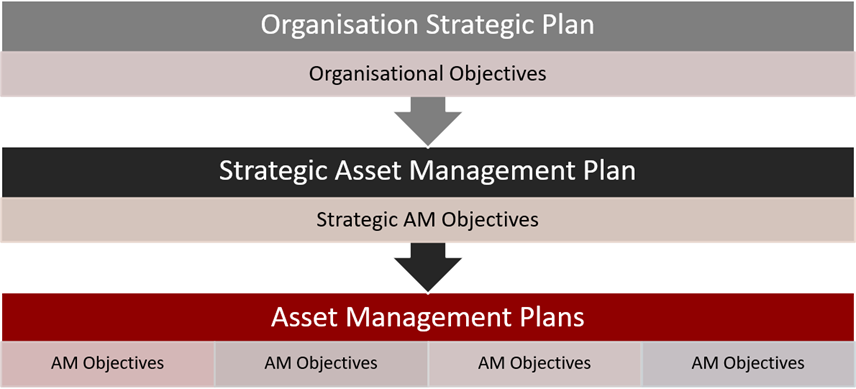
Plans (Strategic Asset Management Plans, Asset Management Plans, Operational Plans, Maintenance Plans, Project Plans etc.) then need to be developed which, when executed, will result in achievement of those objectives.
The objectives, and their associated plans, need to be communicated to all who are responsible for executing the plans and achieving the objectives. Everyone in the organisation should know not only what they are expected to do, but why they are expected to do it, and the results that they are expected to deliver.
Organisational discipline and commitment is then required to ensure that those plans are followed, progress towards achievement of the objectives is measured, and plans adjusted as required.
In the same way that the objectives cascade down through the organisation, performance measures should be used to measure results against those objectives, and these then flow back upwards through the organisation. The aim should be the ensure that, if all lower-level objectives are achieved, then the higher-level objectives will also be achieved.
Summary
The power contained in having and using clear, aligned objectives cannot be overstated, yet their importance is often underestimated.
For Asset Management to be effective within our organisation, we need to know what our organisation’s objectives are – the results it is aiming to achieve.
A balanced, integrated, aligned set of SMART objectives defines value. Well-developed plans which are aligned with the achievement of those objectives, and commitment and discipline in delivering those plans will ensure that our Asset Management activities will deliver that value.
If done well, everyone in the organisation will understand what they are expected to achieve and the work that they do will be directed towards the achievement of organisational value.
In the next article in this series, we will discuss why changing behaviours, rather than generating documents, is important if value is to be obtained from an Asset Management improvement program.
This article is part of the Asset Management Value Roadmap series by Assetivity. To read the previous articles in this series, visit:
Article 1: Understanding Asset Management: The Foundation for Value Creation
Article 2: ISO 55000 and ISO 55001: Understanding the Standards and Their Limitations
Article 3: 6 Key Tips for Generating Value from Better Asset Management
Article 4: Understanding What Value Means to Your Organisation
Article 5: Asset Management Involves Everyone
Article 7: The Real Reason Your Asset Management System Looks Good on Paper but Fails in Practice