
This is the eighth article in our Asset Management Value Roadmap series. In the previous article in this series, we made a key observation: people do asset management. If organisations want to improve the way they manage their assets, they need people to change their behaviours. If those improvements are to be sustained, those behaviours must become habitual. In other words, changing asset management performance requires changing the organisation’s culture.
What is Organisational Culture?
The IAM states:
“An organisation’s culture, therefore, comprises an interlocking set of goals, roles, processes, values, communication practices, attitudes and assumptions which, together, make up the way things are done around here.”
The organisational culture includes the organisation’s shared vision, values, norms, systems, symbols, language, assumptions, environment, location, beliefs, and habits that guide how members approach their work and interact with each other. In essence, it’s:
- A shared meaning of work.
- A social construct.
- Something that can be multilayered within the same organisation.
A simple definition is “the way we do things around here”. It underpins the behaviours that can be observed in an organisation.
It is important to note that a functional culture creates alignment between:
- What the people who work for the organisation value, and
- What needs to be valued for the organisation to succeed.
Creating a Successful Asset Management Culture
It is tempting to believe that organisational culture “is what it is” and cannot be changed. This can feel particularly true for people working at lower levels of an organisation. The good news is that culture can be changed. The bad news is that meaningful cultural change takes time, sustained effort and, to be most effective, requires visible leadership from the top of the organisation. People at lower levels can still influence and develop a sub-culture within their own sphere of influence, although the extent of that change will usually be constrained by the broader organisational culture.
The key steps involved in creating a successful Asset Management culture are:
- Define the desired culture.
- Assess the current organisational culture against the desired culture.
- Implement the required culture change interventions.
Evaluate the success of those interventions
What type of Organisational Culture supports effective Asset Management?
Effective asset management thrives in a proactive, cross-functional engagement culture where all departments (engineering, finance, operations, maintenance, procurement, HR) share accountability and language. This environment relies on data-driven decision making, a continuous improvement mindset, and a unified understanding of the importance of optimising value over entire asset lifecycles rather than focusing solely on short-term fixes.
Key pillars of this cultural ecosystem include:
- Focus on value: Ensuring that all asset management activities are aligned with the delivery of maximum value to the organisation.
- Cross-functional collaboration: Breaking down operational silos so teams align on common goals and work together to deliver value for the whole organisation, not just their part of it.
- Personal accountability and discipline: Building a genuine appreciation for compliance, risk mitigation and clear processes.
- Evidence-based decision making: Replacing subjective opinions with objective, data-driven and analytics-backed strategies to predict issues and prevent downtime.
- Sustainability and lifecycle focus: Shifting the focus from simply fixing broken items to optimising the whole-of-life value and environmental impact of assets.
A common understanding of these foundational elements helps organisations move from a reactive, short-term fire-fighting culture to one that is more proactive and strategic.
How can you assess Organisational Culture?
Employees are often not well placed to assess their organisation’s culture objectively, especially if they have worked there for a long time or have had limited experience in other organisations. When you first join an organisation, its ways of working can feel unfamiliar, and it may take time to understand the behaviours expected of you. Over time, however, you adapt your behaviours to “fit in” with the way the organisation works, and those behaviours eventually become “normal”. For these reasons, it is often wise to assess organisational culture using an external party, an objective methodology, or a recognised model.
There are various cultural models which you can use to assess organisational culture. Some of these are in the public domain, others are proprietary and copyright. The validity of some models has been tested through rigorous academic research, others have not.
Some cultural assessment models that you may wish to explore include:
It is beyond the scope of this article to compare alternative models or recommend one over the other, but many culture types exist as can be seen in the figure below.
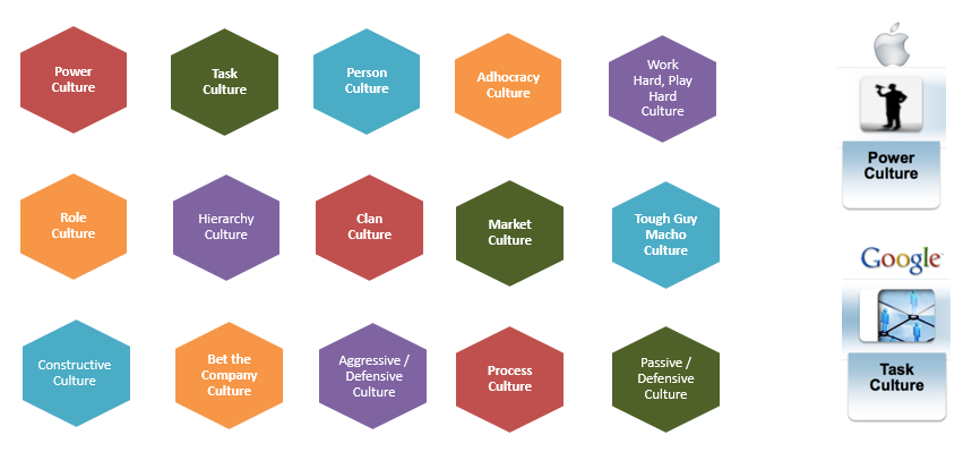
Figure: Different Culture Types
What tools can be used to change Organisational Culture?
Several tools can be used to change behaviours. When applied consistently over time, these tools can contribute to cultural change.
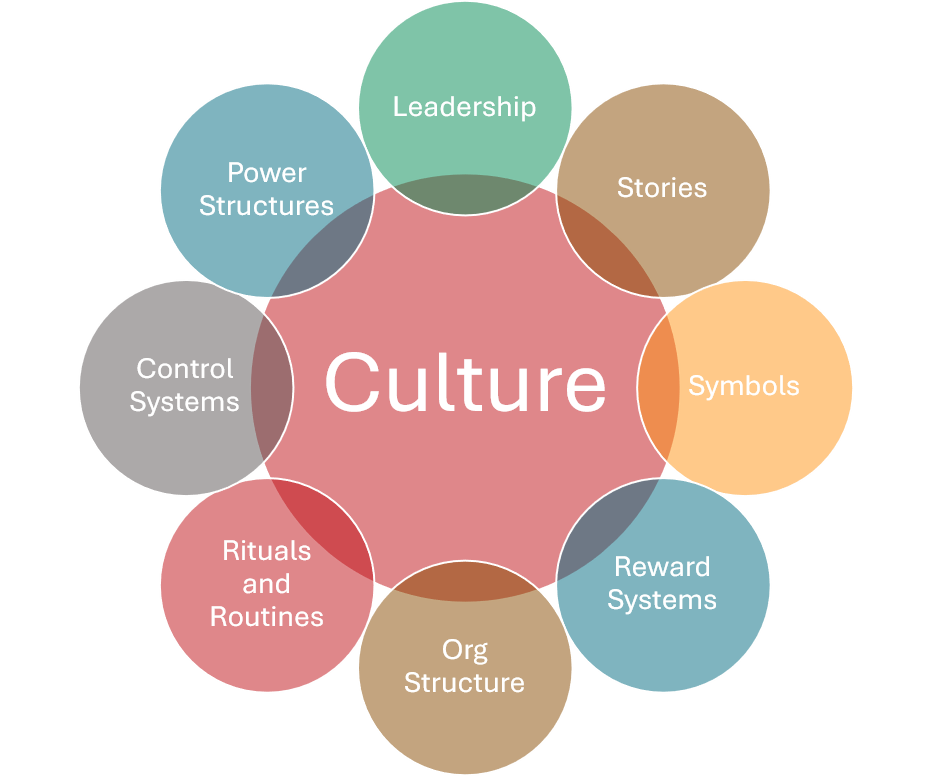
The following sections outline some of the main levers that can influence organisational culture.
Leadership
We discussed the importance of leadership and leadership tools when we explored the Denning model in the previous article in this series. We will not repeat that content here. However, one important leadership attribute is for leaders to demonstrate, through role-modelling, the behaviours and actions that align with what the organisation needs to value most. Through conversations and persuasion, leaders can also help others identify and strengthen the connection between their personal values and the organisation’s values.
Rituals and Routines
Rituals and routines form part of the foundation of organisational culture. Repeated routines operationalise values by turning daily behaviours into norms. Rituals add meaning to these routines: routines dictate what is done, while rituals explain why it is done.
As an example, consider the ritual, commonly practised in asset-intensive organisations, of starting each meeting with a “Safety Share” or equivalent. This reinforces the belief that safety is the organisation’s number one priority, as it is the first item discussed at each meeting. This belief can be further reinforced by recognising and celebrating key safety milestones, such as working for a year without a Lost Time Injury.
Control Systems
The way that the organisation controls activities and behaviours has a significant influence on organisational culture. Some of the different control methods include:
- Results-based control. This is heavily tied to the achievement of KPIs and targets. It creates a culture that is focused on achievement and competition. But if KPIs and targets are overly weighted towards individual achievements, or if they are not aligned with the achievement of higher-level organisational objectives, they can detract from the implementation of collaborative, coordinated processes which maximise the value obtained from the organisation’s assets.
- Bureaucratic control. This relies on compliance with formally documented processes and procedures. Individual initiative and innovation are discouraged, and audits are often used to assess compliance. This builds an organisational culture focused on compliance and risk-aversion.
- Values-based control. This gives individuals flexibility in decision-making for as long as their decisions align with the organisation’s purpose and values. It encourages innovation and inspires commitment by supporting alignment of individual values and purpose with those of the organisation rather than by imposing rules.
Organisations will often employ a mix of all of these control systems; it is the relative emphasis or weighting given to each of these that helps to influence organisational culture.
Organisation Structure
Organisational structure influences how information flows through the organisation, how decisions are made and how resources are allocated. Some of the cultural attributes of different types of organisation structure are outlined below.
- Tall hierarchical structures: These have multiple layers of management, strict chains of command and formal communication methods. They tend to support top-down decision-making and are often aligned with bureaucratic control methods.
- Flat horizontal structures: These remove layers of middle management and may support decentralised decision-making and authority. They may promote a culture of autonomy and trust and foster cross-functional collaboration. They tend to align with results-based control.
- Functional structures: These group employees by functional area based on specialised skills, such as engineering, HR, operations, maintenance and IT. While they support specialist expertise and operational efficiency, they can also contribute to “siloed” cultures where departments struggle to communicate or collaborate effectively.
- Divisional structures: These group employees by product, geography, such as an operating site, or customer segment. Each group contains people with different functional skills, such as engineering, HR, operations, maintenance and IT. This structure can support greater autonomy, decentralised decision-making and local cross-functional collaboration. However, the depth of available technical expertise may be lower, and communication and knowledge sharing between divisions may suffer.
It is also possible for organisations to develop sub-cultures within individual sites, departments or workgroups, using some of the other tools that we discuss in this article – but their ability to do so, and the extent to which each sub-culture varies from the culture of the parent company will depend largely on the degree of autonomy or independence granted to each department or workgroup.
Physical Office Layouts
Improved cross-functional collaboration can often be achieved by changing how and where individuals are physically located, without modifying the organisation structure and formal reporting relationships. Culture and behaviours are often shaped by the informal communications that happen within work teams. Co-locating individuals from different departments within the same work area can often facilitate informal corridor and water-cooler conversations, which in turn build trust and a greater appreciation for the challenges and opportunities that others in the organisation face. In my experience, organisations where maintenance and operations personnel work in the same building tend to have better working relationships than those that occupy different buildings, for example.
Similar principles can apply to office layouts. An open-plan office tends to facilitate greater informal communications and conversations, trust and collaboration than offices where everybody occupies their own individual office – though it should be recognised that individuals often have personal preferences for one or other of these arrangements.
It is also worth considering the impact of remote working compared with working arrangements where all team members are physically present in the same area at the same time. While remote working (via Teams, for example) can support a culture of autonomy and flexibility and may improve productivity, the absence of casual, in-person interactions can lead to feelings of disconnection and hinder the development of a team-based, collaborative culture.
Reward Systems
Reward systems are a powerful lever for shaping organisational culture. Reward frameworks signal exactly what a company truly prioritises. What gets rewarded gets repeated.
Rewards can be financial or non-financial, and tangible or intangible. Examples of financial rewards include bonuses, promotions and pay increases. Non-financial tangible rewards could include providing branded polo shirts when a safety milestone is achieved or holding a celebratory barbecue when a production target is reached. An intangible reward could take the form of public or private praise for the team or individuals involved.
Aspects of the reward system to consider when using it to shape organisational culture include the following:
- Reward the right behaviours – ensure that the behaviours you reward are aligned with the culture you want to create. For example, only rewarding adherence to existing processes and practices is unlikely to drive innovation.
- Align financial compensation with the behaviours you want to encourage – bonuses and commissions based on individual performance are likely to encourage competition, while team-based bonuses and shared KPIs encourage cooperation and teamwork.
- Align rewards with business objectives – this helps build commitment to, and alignment with, the organisation’s success.
- Ensure reward systems are fair and equitable – when reward systems are perceived as fair, they build trust and increase commitment to the behaviours being encouraged. If rewards appear arbitrary, or individuals feel they have little control over whether they receive them, behaviours are less likely to change.
Symbols
Symbols are the most visible artifacts of organisational culture. They translate abstract values into tangible, everyday realities that influence employee behaviour, communication, and cohesion.
Symbols act as visual, verbal, or physical representations of the organisation’s values. They can help to unite teams by creating a common language and understanding of the behaviours that are expected and reminding people of the actions expected of them.
Some examples of symbols include:
- Physical Symbols – For example dress codes which indicate the level of formality expected within the organisation – who wears a suit and tie, who wears an approved company uniform etc.
- Verbal Symbols – slogans and jargon that create a sense of alignment and shared community – for example Nike’s “Just Do It”.
- Rituals and Routines – as discussed earlier in this article.
Power Structures
Who holds authority, information, and influence within an organisation has a profound influence over the organisation’s culture. It shapes communication, decision-making speed, and risk tolerance.
Charles Handy has described four different cultures, based on the way that power is exercised within the organisation.
- Power Culture – in this culture, power is concentrated in the hands of a few leaders or a single founder. This enables rapid decision-making but can also lead to a culture of compliance where staff look solely to those holding the power to make decisions. This, in turn, potentially leads to risk-aversion and a reluctance to express dissenting views and opinions.
- Role Culture – in this culture, authority is delegated through defined roles, hierarchies and rules. While this provides a degree of certainty and predictability, it can also lead to a culture where innovation is stifled and following the appropriate decision-making processes is more important than delivering the best outcomes
- Task Culture – in this culture, cross-functional teams form to solve specific problems or handle projects; decision-making power rests with those that have the greatest expertise rather than being based on formal roles or job titles. This can assist with the development of a highly collaborative, creative, and agile organisational culture.
- Person Culture – here, the organisation is seen as existing primarily to serve the needs of individual experts within the organisation. It leads to a culture of autonomy and individual excellence, rather than supporting collaboration and cross-functional alignment.
Stories
Stories are a powerful tool for shaping organisational culture. They transmit values, build collective identity and help unite communities. More than entertainment, stories define norms, establish ethical expectations, and can help preserve or change an organisation’s culture. Stories transfer institutional knowledge and translate abstract values into tangible, repeatable behaviours.
When used appropriately they can:
- Connect individuals to the organisation’s purpose: Stories about how an organisation began and why it exists help employees find the “why” behind their daily tasks, supporting engagement.
- Reinforce desired behaviours: Highlighting employees who go above and beyond creates “hero” narratives that show the workforce what behaviours the company values.
- Encourage safe innovation: Sharing stories of calculated risks that initially failed but led to valuable lessons can help embed psychological safety and a growth mindset.
How can you use these tools to change Organisational Culture?
Your ability to use these tools will depend on your position in the organisation. For example, if you work at a relatively low level, you are unlikely to be able to influence the organisation structure or the corporate reward system. Even if you can influence these elements, changing them is likely to require significant time and effort.
Although these elements may be among the most powerful influences over organisational culture, the ability to change them usually sits with senior management. This is one reason why cultural change is more effective when it is led from the top of the organisation, rather than driven from the bottom up.
Fortunately, individuals can still use many of the tools above to shape the culture within their own sphere of influence. Practical actions include:
- Document and publish the values and behaviours you want to promote – avoid broad “motherhood” statements such as honesty and integrity. Instead, use statements such as “we work as a team to develop innovative solutions to solve our problems” or “we make sure that our work delivers true value to our customers”.
- Lead by example – apply the leadership tools described in the previous article in this series to demonstrate and promote the behaviours you expect from others. Support this through careful use of the Management tools described in that model and try to avoid relying on Power tools.
- Create rituals – for example, start each meeting not only with a safety share, but also by asking for examples of where people have demonstrated the values and behaviours expected of them.
- Reward the right behaviours – even if you cannot influence the corporate reward system, you can still recognise desired behaviours through public praise and other methods, such as “team member of the month”.
- Tell stories – seek out examples of behaviours that align with the culture you want to encourage, turn them into stories, and share them publicly through pre-start meetings, weekly meetings, monthly meetings or newsletters.
Summary
In summary, this article made the following key points:
- Organisational culture is “the way we do things around here”: the shared values, assumptions, routines and behaviours that shape how people work and interact.
- A successful asset management culture aligns what people value with what the organisation needs to value to achieve its objectives.
- Effective asset management depends on a proactive, cross-functional culture focused on value, accountability, evidence-based decision making, continuous improvement and whole-of-life asset outcomes.
- Culture can be assessed using structured models and objective methods, and external support can help overcome the blind spots that often arise when people are embedded in an organisation for a long time.
- Cultural change requires a clear definition of the desired culture, an assessment of the current culture, targeted interventions, and evaluation of whether those interventions are working.
- Leaders shape culture through role modelling, conversations, rituals, routines, control systems, organisation design, office layouts, reward systems, symbols, power structures and stories.
- While organisation-wide cultural change is most effective when led from the top, individuals can still influence the culture within their own sphere by defining expected behaviours, leading by example, creating rituals, recognising desired behaviours and telling stories that reinforce the desired culture.
This article is part of the Asset Management Value Roadmap series by Assetivity. To read the other articles in this series, visit:
Article 1: Understanding Asset Management: The Foundation for Value Creation
Article 2: ISO 55000 and ISO 55001: Understanding the Standards and Their Limitations
Article 3: 6 Key Tips for Generating Value from Better Asset Management
Article 4: Understanding What Value Means to Your Organisation
Article 5: Asset Management Involves Everyone
Article 6: Align Every Decision With Organisational Objectives
Article 7: The Real Reason Your Asset Management System Looks Good on Paper but Fails in Practice