
This is the seventh article in our Asset Management Value Roadmap series. This series of articles is designed for asset managers, senior leaders, and operational decision-makers seeking to obtain greater value from their organisation’s physical assets.
One of the key weaknesses in ISO 55001 is that it is very document-centric. It mandates the establishment and maintenance of many documents, including an Asset Management Policy, a Strategic Asset Management, Asset Management plans and others.
However, documents only have power if they are read and used, and if any guidance or instruction within them is followed. All of this is performed by people, and so people, and their behaviours, are the (often missing) link between alignment or conformance with ISO 55001 and the delivery of business value. In short, people do Asset Management, so if you want to improve Asset Management performance, then you will need people to change their behaviours. In this article, we will discuss how to achieve this.
Behaviours Drive Value – not Documents
Sustainable improvement in business performance comes from changing how people behave, not from adding yet another binder of documents. The core argument is simple: behaviours drive asset management outcomes, while documents only describe them. When organisations focus too heavily on plans, processes and procedures, they often create an illusion of maturity – polished frameworks that look compliant but fail during execution. Sustainable business improvement demands something deeper: people consistently making the right decisions at the right time.
Behavioural alignment matters because ISO 55001 is fundamentally about defining and understanding the value the organisation is striving to achieve (see Article 3 in this series ), identifying the risks associated with delivery of that value, and making effective decisions within all relevant functions and at all relevant levels within the organisation that will deliver the expected value while managing those risks. These are human activities. A beautifully written risk matrix is useless if teams bypass it. A lifecycle plan adds no value if procurement defaults to lowest‑cost choices out of habit. When behaviours don’t match intentions, the system becomes theatre – compliance on paper, an illusion in practice.
Policies, plans and procedures still matter, but they should be tools, not the destination. They support people; they don’t replace judgement. Organisations that prioritise behaviour build agility, because people can adapt even when documents lag behind reality. They build resilience, because decisions remain aligned with the delivery of value even under stress. And they build credibility, because auditors quickly see the difference between a system that exists on paper and one that exists in practice.
The organisations that truly deliver value through alignment with ISO 55001 are those that invest in behavioural change, not just documentation. The question worth exploring next is how to shape those behaviours.
Change is an Emotional Process
It is important to understand that behavioural change is an emotional process and it is influenced both by human psychology and physiology. Numerous research papers have demonstrated that different parts of our brains influence our behaviours in different ways. More specifically:
- The Limbic System is the part of the brain involved in our behavioural and emotional responses. It turns sensory perceptions into emotional and physical responses. This happens subconsciously and very quickly.
- The Cerebral Cortex is our mental control centre. Amongst other things, it is responsible for decision-making, problem-solving, conscious thought, attention and emotional and behavioural control. It is where we process data rationally, but it requires more energy and does this more slowly than the Limbic system. We often bypass the cerebral cortex and take mental shortcuts and form habits to minimise the amount of time and energy we spend making routine decisions.
Further, our brains are programmed to avoid losses. The pain of losing is psychologically twice as powerful as the pleasure of gaining. This often means that our initial response to a change is negative, created by an emotional fear of loss.
The net result of research in this and related areas is:
- Emotion drives reason more than reason drives emotion
- Feelings happen before thought, and they happen at great speed
- Conscious thought is only a small portion of mental activity
- We perceive matters in ways that emotionally protect our habits and biases
There are two key implications of this for influencing people’s behaviours:
- First, if we want people to do things differently, we need to deal with the emotional impact of that change before we deal with the rational aspects of that change. In other words, we need to engage with people’s hearts before their heads.
- Second, we need to recognise that, given most people’s reliance on mental shortcuts and habits, it will take considerable time to overcome those shortcuts and establish new habits.
Approaches for Changing Individuals’ Behaviours
There are many models for changing behaviours. In this article we will focus on two – one, based on a Forbes magazine article by Steve Denning, which is most useful when used at an individual level – by one person seeking to influence the behaviour of another (or a small number of others). The other, Prosci’s ADKAR model, is more useful when used as part of an organisational change initiative.
Regardless of which model you use, the most important thing is that a proactive approach is taken to managing behavioural change. One of the pitfalls of our emotional brain is that it requires powerful rational proof to overcome the initial, emotional decision that we made – especially if this initial response is negative. For this reason, it is important that we proactively manage this initial emotional response. Attempting to recover the situation in a reactive manner will take considerable additional effort, is fraught with risk, and may not be successful.
The Denning Model
One useful model that describes the various tools that can be used by leaders for changing individuals’ behaviours is outlined in an article by Steve Denning (read How Do You Change an Organizational Culture?) in Forbes magazine. This diagram is reproduced below.
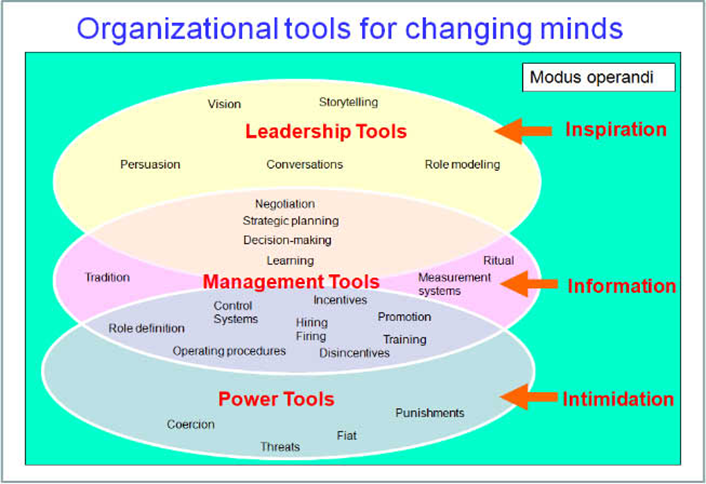
Figure 91 – Tools for Changing Organisational Culture
This diagram distinguishes between Leadership Tools, Management Tools and Power Tools.
Using Power Tools such as coercion, threats and punishment can potentially lead to short-term, grudging compliance, but any behavioural changes will not be sustained (“the floggings will continue until morale improves”). Use of these tools should be avoided except in the most extreme circumstances.
Management Tools such as performance measures, incentives, processes and procedures (and documentation such as Asset Management Policies and plans) tend to appeal to our rational brains. If we are looking to change behaviours, this is necessary, but not sufficient. There are many smokers in our society even though they know that smoking is hazardous to their health; many people drive faster than the speed limit, even though they know that there are hazards (and potential penalties) associated with this. In both of these cases, our emotional brains are over-ruling our rational brains.
Given our earlier point that emotion drives reason more than reason drives emotion, if we want to change behaviours, it is important that we start by engaging peoples’ emotional brains. Many of the Leadership tools in Denning’s model are aimed at achieving this. Things that we can do include:
- Creating an inspiring vision of the future
- Holding one-on-one two-way conversations to create emotional connections, mutual respect and understanding – first connect before you attempt to convince
- Sharing success stories which celebrate and reinforce the behaviours we would like to see
- Acting as a role model – “do as I do, not just what I say”.
Many people are more comfortable using the Management Tools than the Leadership Tools. However, those that swing the balance to increase their use of Leadership Tools frequently achieve great results – these are the ones that you see collecting the awards for outstanding performance.
Prosci’s ADKAR model
The ADKAR model consists of the following elements:
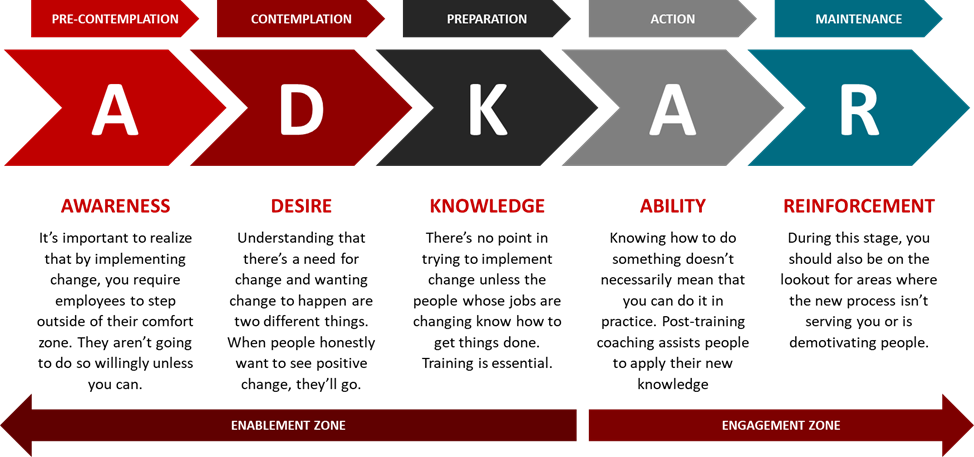
Figure 99 – The ADKAR Model
· Awareness – this is the first step in the journey. People need to be aware that they will need to do things differently. Give them time to do so before hitting them too hard with the change.
· Desire – we need to deal with the WIIFM question at this point – what is in it for me? Need to identify and address people’s concerns and emphasise the benefits of the change.
· Knowledge – training is the key here – we need to make sure people know what it is they need to do differently and how to do it.
· Ability – this is about translating knowledge into competence. Learning in theory about how to do something is quite different to actually being able to do it. Sometime extensive practice and coaching assistance is required.
· Reinforcement – this is about ensuring that people don’t slip back into the old ways. Continue to be aware of barriers that prevent adoption – you may need to change your processes to make it easier for people to comply with them.
Note that the ADKAR model recognises that behavioural change is a process, and that this process takes time. It takes a proactive approach and deals with the emotional response to change first (there is a change coming, and here is what it might mean for you) before engaging with the rational brain (here is what we expect you to do to implement the change).
In summary, this article made the following key points:
- A key weakness of ISO 55001 is its document-centric approach
- Real value comes from aligning people’s behaviours with the achievement of organisational goals, not through preparing documents.
- Behavioural change is an emotional process influenced by the psychological and physiological characteristics of the human brain.
- Our brains react to emotions more quickly than rational arguments. A proactive approach addressing emotional factors is required if success in implementing behavioural change is to be achieved.
- We outlined two models that can assist in guiding behavioural change:
- Steve Denning’s model emphasises the use of leadership tools such as conversations and role modelling in preference to the use of coercion or management tools.
- Prosci’s ADKAR model outlines a staged process involving Awareness, Desire, Knowledge, Ability, and Reinforcement to support lasting change.
Focusing on behaviour also accelerates cultural change. When leaders model desired behaviours, when technicians feel ownership of data quality, when planners and engineers challenge decisions that undermine long‑term value, the organisation begins to live ISO 55001. This creates a self‑reinforcing loop: better behaviours lead to better outcomes, which strengthen belief in the system, which further embeds the behaviours. We will discuss this issue of culture transformation in the next article in this series.
This article is part of the Asset Management Value Roadmap series by Assetivity. To read the other articles in this series, visit:
Article 1: Understanding Asset Management: The Foundation for Value Creation
Article 2: ISO 55000 and ISO 55001: Understanding the Standards and Their Limitations
Article 3: 6 Key Tips for Generating Value from Better Asset Management
Article 4: Understanding What Value Means to Your Organisation
Article 5: Asset Management Involves Everyone
Article 6: Align Every Decision With Organisational Objectives