
In this article, we will revisit and expand on the concept of value introduced in the first article in the series. We also discuss the importance of having an integrated and aligned set of SMART objectives to articulate that value.
In summary, if your organisation lacks a shared understanding of what “value” means and has not developed a cohesive set of SMART objectives, it becomes very difficult to align people, systems, and processes to deliver that value effectively.
What is Value?
As mentioned in the previous article in this series, in most asset-intensive organisations, if you were to ask ten people what “value” means, you often get ten different answers.
ISO 55000:2024 defines value as “results from satisfying needs and expectations.” This naturally raises the question: whose needs and expectations? The answer is: your relevant stakeholders.
Unfortunately, stakeholder expectations often conflict. Owners expect returns. Customers want low cost and high quality. Environmental and safety regulators expect compliance with different sets of requirements. Local communities look for social benefits. Senior executives focus on economic and reputational risk.
Because these expectations are not fully compatible, no organisation can satisfy all stakeholders completely. Trade‑offs are inevitable. This balancing act is one of the “arts” of effective Asset Management.
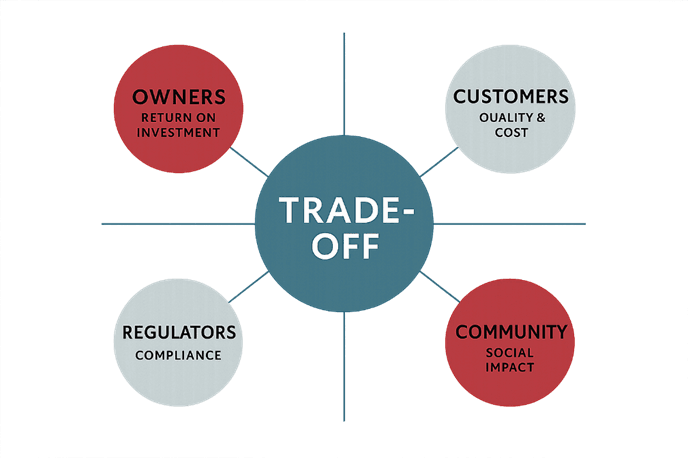
We can think of stakeholder needs across four dimensions: Cost, Benefit, Risk, and Time. All Asset Management decisions require trade-offs across these dimensions.
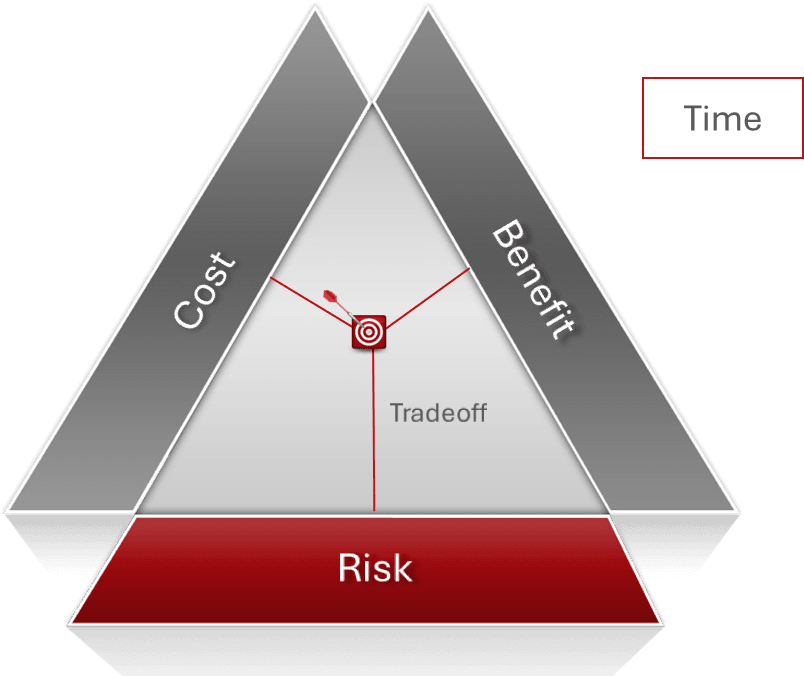
The point where these trade‑offs balance effectively is the organisation’s view of value, the place where stakeholders are most likely to accept the compromise.
The challenge is ensuring that all asset management and business decisions align with this agreed view of value. So how should we achieve that consistent, aligned view of business value across the organisation? The starting point for fixing this is developing clear, specific objectives. And this is where most organisations stumble.
The Power of SMART Objectives:
The concept of SMART objectives, standing for Specific, Measurable, Achievable, Relevant, and Time-bound, is well established in management practice. And yet it is remarkable how rarely it is applied rigorously in asset management.
Here is something worth noting. ISO 55001 only requires objectives to be measurable “where practicable.” Going beyond these minimum requirements and making objectives truly SMART takes more effort upfront, but it pays dividends in terms of the clarity and focus it brings to everything that follows.
Goals vs Objectives: Understanding the Difference:
ISO 55000:2024 defines an objective as a result to be achieved. Simple enough. But in practice, what we frequently see organisations calling “objectives” are actually goals dressed up to look like objectives.
So, what is the difference between goals and objectives?
A goal is a broad, aspirational statement of direction. It is useful for motivating people and providing a general sense of where the organisation is heading, but it lacks the specificity needed to guide day-to-day decision making. Goals are typically long-term in nature and difficult to measure with precision.
An objective, on the other hand, is specific, measurable, and time-bound. It tells you exactly what needs to be achieved, by when, and to what standard. It gives decision-makers at every level of the organisation a clear reference point for prioritising activities and allocating resources.
| Goals | Objectives |
| Little detail | More specific, detailed |
| Longer term, strategic | Can be both longer term or shorter term |
| Sets a general direction | Provide more detail regarding results to be achieved |
| Creates a need for changes | Provide direction regarding which changes are required |
| Achievement may not be easily measured | To be effective, achievement (or progress towards achievement) should be measurable |
| Timeframe for achievement may not be specified | To be effective, timeframe for achievement should be specified |
Many organisations publicly list goals but call them objectives. While these statements can be inspiring, they do not help people allocate resources or make trade-offs when priorities compete.
For example, a major publicly listed organisation states the following as being their corporate objectives:
- Become Best Operator, through great teams bringing their best every day, to safely and sustainably realise the full value of our assets.
- Strive for impeccable ESG credentials by aligning our priorities with society’s expectations and considering safety and sustainability in every decision.
- Excel in development by shaping our portfolio for the future while progressing our existing project pipeline on time and to budget.
- Strengthen our social license by building meaningful partnerships, listening and learning, and earning trust.
These statements are admirable. They are motivating. They give a general sense of the organisation’s direction. But if you were managing an asset portfolio with limited funding and had to decide which of these priorities to focus on, how would you choose? What if delivering “impeccable ESG credentials” required investment that came at the expense of “realising the full value of our assets” from a financial perspective?
Now contrast those with the following example from a rail organisation:
- Achieve zero fatalities as a result of asset failures across all rail lines.
- Achieve rolling stock reliability of 1,000k train-km between failures by 2028 and 1,500k train-km between failures by 2032.
- Commission by 2030 an asset information system that supports a predictive and preventive maintenance regime and lifecycle cost analysis.
- Implement a Risk Management Framework and complete assessment of asset criticality across the entire asset base by 2030, with maintenance, replace, and renewal decisions driven by this framework by 2032.
- Obtain ISO 55001 certification by 2028.
- Optimise train fleet to achieve maximum peak period passenger loading of less than 4 passengers per square metre.
The difference is immediately apparent. For example, if your rolling stock reliability in 2025 is 500,000 train kilometres between failures and you know it needs to reach 1,000,000 by 2028, you know that transformational change is required– not a small, incremental improvement. That is genuinely useful.
The bottom line: if your organisation cannot articulate specific, measurable outcomes for its asset management activities, it will struggle to generate consistent value from them.
SMART Objectives are Necessary but not Sufficient
Even when organisations set SMART objectives, they may not consider how these objectives interact. Safety, production, and budget targets are often set independently. Each may be achievable in isolation, but not simultaneously.
When objectives conflict, departments optimise for their own success rather than organisational value. Environmental initiatives may undermine production targets, or budget cuts may compromise reliability.
Without an integrated suite of consistent objectives, decision‑making becomes fragmented.
The Way Forward
So how do you make sure that value is clearly articulated in a way that supports effective, co-ordinated decision-making? Here is a suggested process.
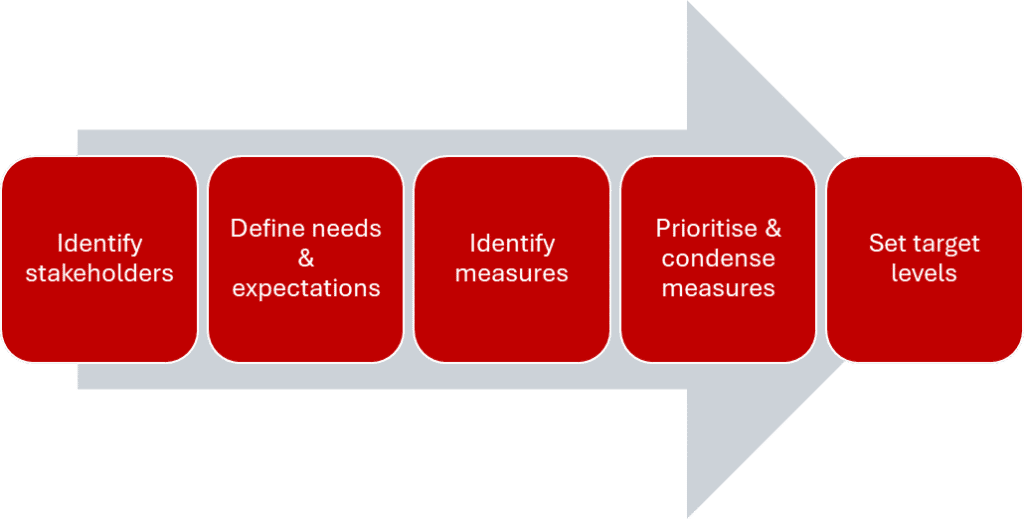
- Start by identifying your key stakeholders. What are their needs and expectations?
- How would you measure whether you are meeting their needs and expectations? For each stakeholder, identify what you would measure to assess stakeholder satisfaction – e.g profit, product quality, regulatory compliance etc.?
- Trim these measures to a smaller, balanced set of measures – consider using Kaplan and Norton’s Balanced Scorecard approach.
- Establish the target levels of performance that are required, for each of those measures, to meet stakeholders’ needs and expectations?
- Assess whether all of these targets can be achieved simultaneously. If they cannot, then consider how to adjust one or more of those targets so that they can be achieved as a coordinated suite of objectives.
This process requires collaboration across many business functions and usually demands executive involvement. It may take time, involve multiple workshops, and require facilitation to navigate political or functional barriers.
However, the effort pays off. A balanced, aligned suite of SMART objectives provides a strong foundation for coordinated planning and value delivery.
Summary
In summary,
- It is important to understand that value is multi-dimensional
- Delivering value requires a trade-off between Benefits, Costs, Risks and Time
- Developing SMART objectives can assist in articulating the point of optimum trade-off between these four dimensions
- Developing an integrated and aligned suite of objectives is likely to be complex and time-consuming but is well worth the effort.
In the next article in this series, we will discuss the scope of Asset Management, identify which functions within an organisation are involved in Asset Management, and discuss the implications of this for coordinating activity to realise value from assets
This article is part of the Asset Management Value Roadmap series by Assetivity. To read the previous articles in this series, visit:
Article 1: Understanding Asset Management: The Foundation for Value Creation
Article 2: ISO 55000 and ISO 55001: Understanding the Standards and Their Limitations
Article 3: 6 Key Tips for Generating Value from Better Asset Management