

Many organisations pursue ISO 55001 certification, believing it represents the pinnacle of Asset Management excellence. Yet certification alone does not guarantee value creation. This article (the second in our Asset Management Value Roadmap series) explores what guidance ISO 55000 and ISO 55001 provide, their role as reference frameworks, and critically, why conformance with these standards is necessary but not sufficient for maximising organisational value from Asset Management.
What is ISO 55000?
ISO 55000 is the international standard for Asset Management. More precisely, it is a suite of documents that collectively provide a framework for managing assets effectively. As a management system standard, ISO 55000 sits alongside other well-known ISO management system standards such as ISO 9001 (quality management), ISO 14001 (environmental management), and ISO 45001 (occupational health and safety management).
The Core Documents
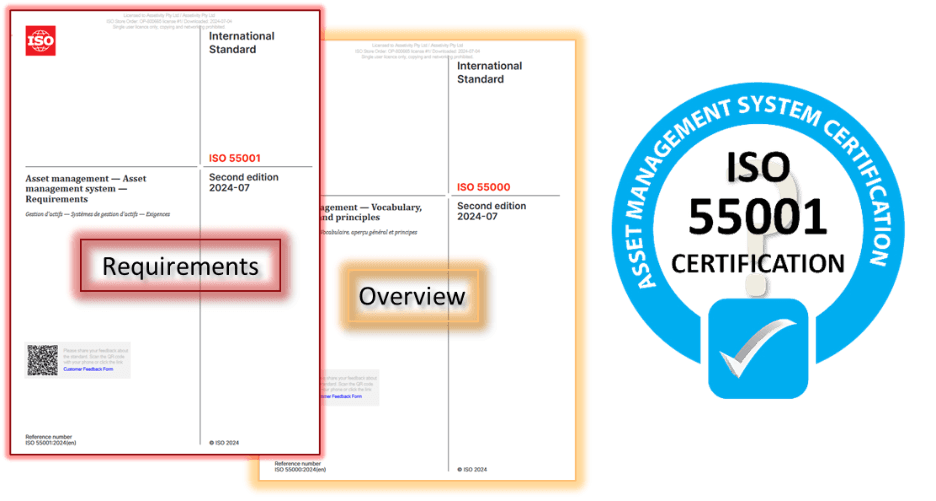
At the time of writing, the ISO 55000 suite comprises two key documents, both updated in 2024, and several supporting guidance documents. The Core Documents consist of:
ISO 55000:2024
This foundational document introduces the key concepts and principles that underpin sound Asset Management. Most importantly, it contains all the definitions of terms used throughout the suite. Understanding ISO 55000 is essential for interpreting the requirements stated in ISO 55001 and for establishing a common language around Asset Management within your organisation.
The 2024 update brought significant refinements to core concepts, including enhanced clarity around value realisation, stakeholder management, and the relationship between Asset Management and broader organisational objectives.
ISO 55001:2024
This is the requirements document. ISO 55001 contains the “shall” statements that outline good practice with regard to an Asset Management system. ISO 55001 is a certification standard; organisations can seek formal certification demonstrating conformance with the requirements of ISO 55001:2024. The requirements in ISO 55001 are structured around the Plan-Do-Check-Act cycle familiar from other ISO management system standards, covering:
- Context of the organisation
- Leadership and commitment
- Planning (including risk management and Asset Management objectives)
- Support (resources, competence, communication, documented information)
- Operation (including operational planning and control)
- Performance evaluation (monitoring, measurement, analysis, evaluation, audit, and management review)
- Improvement (nonconformity, corrective action, and continual improvement)
Supporting Documents
Beyond these two core documents, the ISO 55000 suite includes additional guidance documents such as ISO 55002 (guidelines for the application of ISO 55001), ISO 55010 (guidance on the alignment of financial and non-financial functions in Asset Management), and others. While these supporting documents provide valuable insights and practical guidance, they are not mandatory for conformance with ISO 55001. Organisations can achieve certification by meeting the requirements in ISO 55001 alone, though many find the guidance documents helpful during implementation.
The Value of ISO 55001 as a Reference Framework
ISO 55001:2024 represents the current best reference document for good practice in Asset Management. It consolidates decades of industry experience, academic research, and practical application into a coherent framework. For organisations serious about Asset Management excellence, ISO 55001 provides:
A Common Language
The standard establishes consistent terminology, reducing confusion and misalignment that often plague cross-functional Asset Management initiatives.
A Structured Approach
ISO 55001 provides a logical framework for developing an Asset Management system, ensuring that critical elements are not overlooked.
A Benchmark
The standard enables organisations to assess their current practices against an internationally recognised reference point, identifying gaps and opportunities for improvement.
Stakeholder Confidence
Certification to ISO 55001 demonstrates to stakeholders (investors, regulators, customers, insurers) that the organisation has implemented recognised good practices for managing its assets.
These benefits are real and valuable. So why doesn’t certification or alignment with ISO 55001 automatically generate organisational value?
Why Certification Alone Doesn’t Generate Value
Despite the clear benefits of ISO 55001 as a reference framework, there are several critical reasons why conformance with the standard does not automatically translate to value creation.
1. Genericity Limits Applicability
By necessity, ISO 55001 is a generic document. It is intentionally designed to apply to organisations of any size, in any industry, operating in diverse scenarios. A small municipal water utility, a global mining company, a manufacturing plant, and a defence organisation can all pursue ISO 55001 certification using the same standard.
This genericity is both a strength and a limitation. While it makes the standard broadly applicable, it also means that some content represents good practice across all contexts but not necessarily best practice within your specific organisation, industry, or operating environment.
Example:
The standard requires organisations to establish processes for managing change to assets and the Asset Management system. This is undoubtedly good practice. However, the level of formality, documentation, and governance required for effective change management varies dramatically between a stable, mature utility and a rapidly evolving mining operation in a high-growth phase. ISO 55001 cannot prescribe the specific approach that will create maximum value in your context.
2. Not All Requirements Are Equally Relevant
Some elements of ISO 55001 may not be as relevant to certain organisations as they are to others, given differences in operating situations, risk profiles, regulatory environments, and stakeholder expectations.
This leads some organisations to pursue alignment rather than certification. Alignment means choosing specific elements or clauses of the standard that represent good practice for that organisation and will generate value, while consciously deciding not to implement other requirements that add limited value given their specific context.
The Certification vs. Alignment Decision:
Organisations pursuing certification must demonstrate conformance with all requirements of ISO 55001. Those choosing alignment have more flexibility to focus effort where it will generate the greatest return. Neither approach is inherently superior; the right choice depends on your stakeholders’ expectations, regulatory requirements, and the relative value of formal certification versus pragmatic implementation.
3. Good Practice vs. Best Practice
ISO 55001 represents good practice, not best practice. There is a critical distinction. The standard establishes a baseline, a minimum threshold of competence in Asset Management. Meeting this threshold proves that an organisation is competent and that risks to the achievement of organisational value are contained, but it does not mean that value has been optimised.
The Driver’s Licence Analogy:
Certifying as conforming to ISO 55001 is somewhat like obtaining a driver’s licence for the first time. It proves that the driver is competent and not a danger to others on the road. But it does not mean that they are the best driver possible. They would not be piloting a Formula One car shortly after receiving their probationary driver’s licence. Similarly, ISO 55001 certification demonstrates baseline competence, not excellence.
For organisations serious about maximising value from Asset Management, certification to ISO 55001 should be seen as a foundation, not a destination. Significant opportunities exist to go beyond the minimum requirements of the standard to generate additional value.
4. The Asset Management System Is Not Asset Management
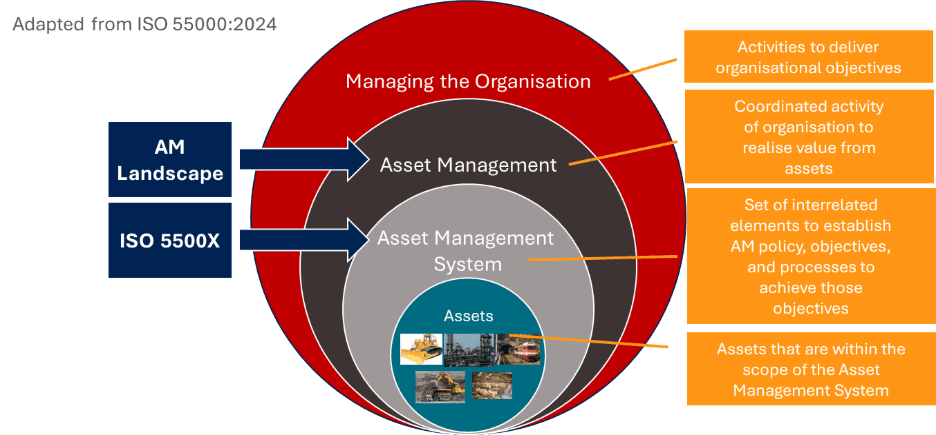
This is perhaps the most fundamental limitation. ISO 55001 is a reference document for what good practice looks like for an Asset Management system. But an Asset Management system is not the same as Asset Management itself.
Definitions Matter:
- Asset Management System (ISO 55000:2024): A set of interrelated or interacting elements to establish policies and objectives, and processes to achieve those objectives for Asset Management
- Asset Management (ISO 55000:2024): Coordinated activity of an organisation to realise value from assets
The Asset Management system is a subset of Asset Management. It is the management framework, the documented policies, objectives, and processes. Asset management, by contrast, consists of the coordinated activity, the behaviours and organisational culture that realise value.
The Critical Gap:
ISO 55001 specifies requirements for the management system (the framework) but does not specify everything required to achieve coordinated activity that realises value (the actual work). The standard tells you what governance, processes, and documentation you should have in place. It does not tell you whether your maintenance strategies are optimal, whether your asset utilisation is maximised, whether your capital investment decisions create value, or whether your operational practices preserve asset life.
You can have a fully conformant ISO 55001 Asset Management system (perfect documentation, clear processes, appropriate governance) while your physical assets deteriorate, your maintenance costs spiral, and your operational performance declines. The system can be perfect while the outcomes are poor.
Beyond Compliance: The Path to Value
Understanding these limitations is not an argument against ISO 55001. The standard provides immense value as a reference framework, a common language, and a structured approach to Asset Management system development. Rather, recognising these limitations clarifies that certification or alignment with ISO 55001 is a means to an end, not the end itself.
The Value Equation:
ISO 55001 provides the structure and governance framework (the “how” of Asset Management). But value is created through:
- Technical excellence in asset strategy development
- Effective implementation of maintenance and operational practices
- Sound decision-making at all levels of the organisation
- Continuous improvement based on performance feedback
- Alignment between asset activities and organisational objectives
These value-creating activities must be identified, prioritised, and executed within the framework provided by ISO 55001. The standard tells you what elements your Asset Management system should contain. The Asset Management Value Roadmap (which we explore throughout this series) helps you identify where and how those elements should create value in your specific context.
Practical Implications for Your Organisation
If You’re Pursuing Certification:
View ISO 55001 as establishing the foundation for Asset Management excellence, not as representing excellence itself. Build your Asset Management system to meet the requirements, but continuously ask: “Beyond compliance, where can we create additional value?”
If You’re Pursuing Alignment:
Be deliberate about which elements of ISO 55001 you implement. Focus your effort on requirements that address your most significant Asset Management risks and opportunities. Document your rationale for not implementing certain requirements to maintain alignment with the spirit of the standard even when not seeking certification.
For All Organisations:
Recognise that the real work of Asset Management happens beyond the documented system. Your Asset Management policy, objectives, and processes provide the framework. The value is created through effective execution: optimising maintenance strategies, making sound capital investment decisions, operating assets to balance production and preservation, and building the capability of your workforce to manage assets effectively.
Conclusion
ISO 55001:2024 provides a valuable reference framework for Asset Management system development. It represents good practice, establishes a common language, and offers stakeholders confidence that recognised approaches are being applied. However, certification or alignment with ISO 55001 does not automatically generate organisational value.
The standard’s generic nature means it cannot prescribe best practice for your specific context. Not all requirements are equally relevant to all organisations. Most importantly, ISO 55001 specifies requirements for the Asset Management system (the framework) but not for all the activities required to realise value from assets (the work itself).
Maximising value from Asset Management requires going beyond compliance to identify and execute the specific technical and operational activities that will drive performance in your organisation. This is the purpose of the Asset Management Value Roadmap.
In the next article in this series, we explore how to identify specific value creation opportunities within your Asset Management approach, moving beyond generic compliance to targeted improvement that delivers measurable organisational benefit.